


Ars Ex Machina: Generative Art and the "Death of the Internet"
Opinion by Javier Lozano

In 2016, a theory about “the death of the internet” gained notoriety on a virtual forum called Wizardchan, where multiple anonymous users joined a post published by IlluminatiPirate to discuss the possibility that the internet was slowly fading away.
Despite how ominous the idea may seem, and how exaggerated the notion of “the death of the internet” might sound, the reality is that it represents a logical construction based on the limited, and increasingly minimal, human interaction that exists within the medium. Genuine interactions and the grand purpose of an accessible and free means of communication are being replaced by content farms and information overload.
Rather than dying outright, the internet now holds a different meaning from the one it once had. The tool that once enabled freedom of expression and communication is increasingly being controlled as a means of influencing our daily decision-making. Artificial intelligence has taken on a central role as an agent of change in the construction of so-called “algorithms.”
All content generated as a means of attracting mass consumption is something we have collectively accepted, and the sense of exploration or adventure has been replaced by endless scrolling. There is nothing more the internet can offer us, and that is fine. We have placed too much pressure on the “medium of the future,” forgetting to appreciate the advantages and opportunities it still provides.
We all actively contribute to living in a world of “trends,” “scrolling,” “fast content,” and videos created through artificial intelligence that attempt to imitate real situations. The idea of consuming artificial and unreal media without possessing the human tools to detect the level of realism with which it was created deeply unsettles me. The invasion of the internet into the real world is potentially a threat to a dignified life.
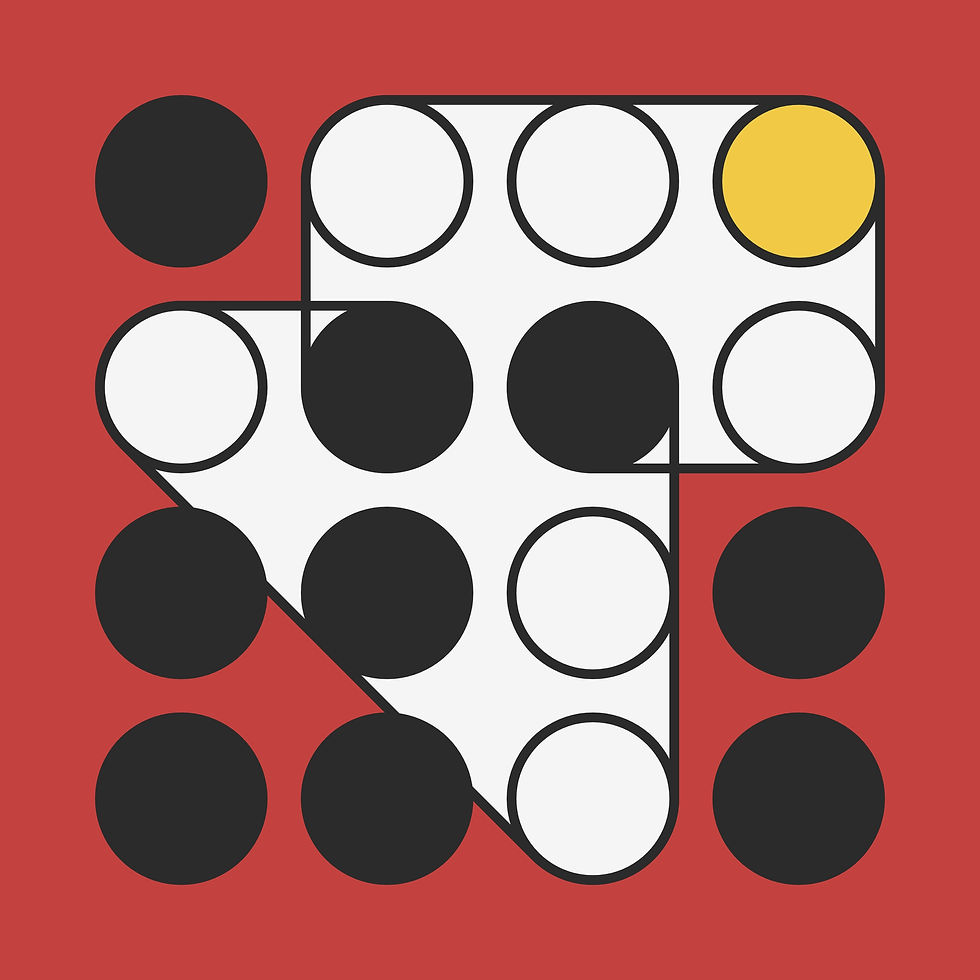
'noisy circles' collection by michelleinspace
Within this context, generative art emerges not as an anomaly, but as a logical consequence of the contemporary internet. Ars Ex Machina (from Latin, Art of the Machine) represents not only the automation of the creative process, but also the aesthetic materialization of a saturated, predictable, and increasingly less human medium.
Just as the internet ceased to be a space of exploration and became a factory of stimuli, art generated by artificial intelligence reproduces forms, styles, and emotions without having lived them.
It is not the end of art, but rather the reflection of a digital ecosystem that no longer requires experience to produce meaning.
To accept Ars Ex Machina as an “inevitable” evolution is to renounce one of the fundamental conditions of artistic practice, lived experience. Creation, understood as a process that passes through the body, memory, and context, dissolves when artistic production is reduced to a statistical combination of preexisting data. In this sense, generative art does not expand the artistic field, instead, it compresses it into a space where it inhabits and feeds upon itself.
Artists and collectives have begun to raise concrete questions regarding intellectual property, artists’ rights, and the role of the creator in relation to these automated systems.
In Montreal and Toronto, for example, festivals such as the Provocation Ideas Festival have provided space not only for exhibitions of AI-generated works, but also for public debates on their social and ethical impact, functioning as forums for reflection beyond mere technological awe.
At the same time, figures such as Dmitri Cherniak, whose generative art project Ringers produced a series of 1,000 unique blockchain-based works (the so-called NFTs), demonstrate how code-based art can become a profitable product without offering a critique of the structural effects of automating creativity.
Its commercial success not only confirms the economic viability of generative art, but also illustrates how these practices can produce new forms of colonization by subordinating the artistic process to the market, financial speculation, and circuits of accumulation that reconfigure our understanding of what creation means.
From my perspective, we must question the place that Ars Ex Machina occupies within a system that confuses generation with creation.
The influence of artificial intelligence, rather than expanding creative possibilities within artistic processes, is slowly consolidating a new form of cultural colonialism, a system that, through algorithms, extracts aesthetic and symbolic value in order to accumulate and commercialize it outside of human experience, the very experience that necessarily gives art its full meaning.



Comments